Working-time records for Mietwagen & taxi

Driver timesheets that hold up when German customs knocks

For every driver you must record the start, end and duration of daily working time, within seven calendar days of the shift, and keep the record for at least two years. That's § 17(1) of the German Minimum Wage Act (MiLoG) for the passenger transport sector (statute, in German).

Schichtzettel ("shift sheet") builds that record from your drivers' Uber and Bolt activity, checks it against the minimum wage and hands the hours to payroll. No paper, no catching up at month end.

Send a request We reply this week

Last updated: 20 October 2026

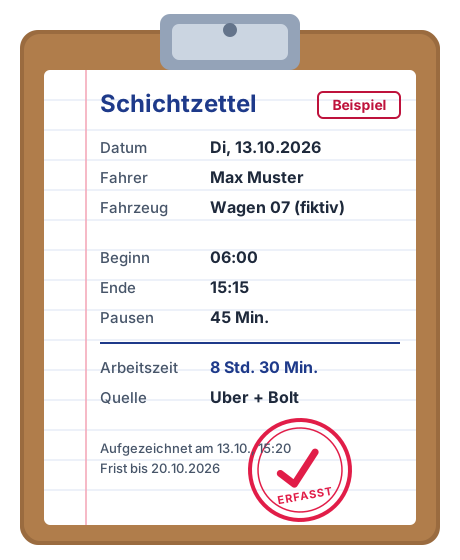
Example of a completed German shift sheet on a clipboard: driver Max Muster, Tuesday 13 Oct 2026, start 06:00, end 15:15, 45-minute break, 8 h 30 min worked, stamped as recorded
Example with fictional data

Required-fields checklist

What every driver timesheet needs

The Minimum Wage Act names three items. The rest makes the sheet easy to follow for an inspector.

  • Start timeWhen the shift actually began. Required by § 17(1) MiLoG.
  • End timeWhen the driver stopped working. Required by § 17(1) MiLoG.
  • Hours worked that dayThe actual duration. Required by § 17(1) MiLoG.
  • BreaksSo the duration adds up: 30 minutes are required for more than six hours, 45 minutes for more than nine (§ 4 of the Working Hours Act, ArbZG).
  • Date and driver nameA record that can't be tied to a day and a person is useless to an inspector.
  • Date the record was madeShows the seven-day deadline was met. Entries backfilled the night before an audit stand out.

Sources: § 17 MiLoG · § 4 ArbZG · exemptions for high monthly pay and family members: § 1 MiLoDokV

Deadlines under § 17 MiLoG

From shift to end of retention: day 0, day 7, 2 years

  1. Day 0: the shift

    The driver works, say on Tuesday 13 October. The recording clock starts.

  2. Day 7: record done

    Start, end and duration must be written down by the end of the seventh following calendar day: midnight on 20 October in this example.

  3. 2 years: keep it

    The record stays available for at least two years and must be produced on request.

Source: § 17(1) MiLoG. On top of that, § 16(2) ArbZG requires you to record any time worked beyond eight hours a day and keep those records for at least two years too (§ 16 ArbZG).

What customs checks

In a Zoll audit, paperwork counts, not memory

In Germany, minimum-wage and undeclared-work checks are run by customs, through its Finanzkontrolle Schwarzarbeit (FKS) unit. Passenger transport is one of the sectors the Undeclared Work Act singles out, and the checks cover reporting duties and minimum-wage compliance (§ 2(1) SchwarzArbG).

ID

Drivers carry their ID

Anyone working in passenger transport must carry an ID card, passport or substitute document and show it on request. As the employer, you must tell each driver about this in writing before they start, in a way you can prove, and keep that notice.

§ 2a SchwarzArbG

Sofortmeldung

Registered by the first shift

In passenger transport, the start of every job must be reported to the pension insurance data office no later than the day work begins (the "Sofortmeldung", or immediate registration). An unregistered driver shows up at once in an interview.

§ 28a(4) SGB IV

Hours × pay

Timesheets and payroll must match

Inspectors compare recorded hours with wages paid. The German minimum wage is €13.90 gross per hour and rises to €14.60 on 1 January 2027. Documents must be kept in Germany, in German.

§ 1 MiLoV5 · § 17(2) MiLoG

up to €50,000

Timesheet missing, wrong or late

It's an administrative offence to fail to make the record, to make it incorrectly, incompletely or late, or not to keep it for two years.

§ 21(1) no. 8, (3) MiLoG

up to €500,000

Minimum wage unpaid or paid late

Once hours and pay don't match, the question quickly moves from paperwork to the wage itself.

§ 21(1) no. 13, (3) MiLoG

The office problem

With 30 drivers, paper timesheets become a weekly chore

Drivers fill in times from memory, sheets get left in the glovebox, and at month end someone in the office reconciles Uber and Bolt exports in Excel, long after the seven-day deadline has passed.

Today: paper, Excel, WhatsApp

  • Times are entered late and estimated.
  • You can't prove the seven-day deadline was met.
  • Platform data and timesheets contradict each other.
  • Nobody checks the minimum wage until customs asks.
Example

Fixed salary meets real hours

Example calculation of effective hourly pay with fictional figures
Gross pay in October (fictional)€2,400.00
Hours on the timesheets186 h
Works out per hour€12.90
Minimum wage 2026€13.90

On paper this driver is €1.00 an hour below the minimum wage. That's the case you want to spot before an audit, not after.

How Schichtzettel helps

The timesheet fills itself from driving activity

Timesheets from Uber and Bolt

Once your Uber Fleet and Bolt Fleet accounts are connected, every driver gets a daily sheet with start, end and duration. You review, add breaks and confirm.

Working time per driver

Days over eight hours, missing breaks or less than eleven hours' rest between shifts (§§ 3–5 ArbZG) show up before they become a habit.

Minimum-wage check

Pay divided by recorded hours, per driver and month. If it falls below €13.90 (€14.60 from 2027), you get a warning.

Payroll export

Confirmed hours go to your payroll or tax adviser in one batch. No retyping, no transfer errors.

Legal basis: § 3 ArbZG (8 hours a day, up to 10 if it averages out over 6 months or 24 weeks) · § 5 ArbZG (11 hours' rest). Germany's Federal Labour Court has also held that employers must record the start and end of daily working time under § 3(2) no. 1 of the Occupational Safety Act, ArbSchG (BAG, order of 13 Sep 2022, 1 ABR 22/21).

Setup

First timesheets in about 48 hours

  1. Add drivers and cars

    Upload them once, with names and employment type, mini-jobbers included.

  2. Connect Uber Fleet and Bolt Fleet

    From then on, trip data flows in automatically for every driver.

  3. Review, confirm, export

    Every morning the office sees yesterday's sheets and confirms them well inside the deadline, not at month end.

From the field

Timesheets in minutes, not hours

5 h/week → under 1 h/month

That's how far timesheet work dropped at one operator that builds its shift records with this software. More than 700 operators use it to run drivers, cars, platform data and their Konzession (operating licence) instead of spreadsheets and WhatsApp groups.

Anonymized customer experience

Price

Price

from $5.99 per driver/month

  • Automatic timesheets from Uber and Bolt
  • Minimum-wage and working-time checks
  • Payroll export
  • 2-day free trial, no credit card
Send a request

FAQ

Questions about driver timesheets in Germany

What does a driver timesheet (Schichtzettel) in Germany have to show?

Under § 17(1) of the German Minimum Wage Act (MiLoG), you must record the start, end and duration of each driver's daily working time. Passenger transport is one of the sectors listed in § 2a of the Undeclared Work Act (SchwarzArbG), so the duty generally covers all your employees. Date, driver name and breaks make the record easy to follow.

How quickly must hours be recorded, and how long do I keep them?

By the end of the seventh calendar day after the day worked. For a shift on Tuesday 13 October, the deadline is 20 October. Records must be kept for at least two years (§ 17(1) MiLoG).

Do part-time and mini-job drivers need timesheets too?

Yes. § 17(1) MiLoG names marginal employees (Minijobber) explicitly, and in passenger transport the duty covers full-time and part-time staff as well. The only exemptions are employees with a steady gross monthly pay above €4,461 (above €2,974 if paid for the last twelve full months) and family members of the employer working in the business (§ 1 MiLoDokV).

Can the timesheet be digital?

§ 17 MiLoG requires start, end and duration of daily working time but does not prescribe paper. What matters is that the record is made on time, is complete, is kept in Germany in German and can be produced during an inspection.

What are the fines for missing or late timesheets?

Failing to make, correctly complete or keep the records under § 17(1) MiLoG is an administrative offence with fines of up to €50,000. Not paying the minimum wage, or paying it late, can cost up to €500,000 (§ 21 MiLoG).

How is the timesheet created automatically, and what does it cost?

Schichtzettel connects to your Uber Fleet and Bolt Fleet accounts and pre-fills start, end and duration for every driver from their activity. You review, add breaks and export the hours for payroll. Pricing starts from $5.99 per driver per month, and setup takes about 48 hours.

Next step

Set up timesheets for your fleet

We'll show you what working-time records look like with your own Uber and Bolt data.

  • 1We get back to you this week.
  • 2A short call about driver numbers, pay model and payroll.
  • 3Setup in about 48 hours.

Send your request

Leave your details — we'll be in touch this week.

By submitting, you agree that we process your details to handle your request. Details in our privacy policy. Required fields are marked *.